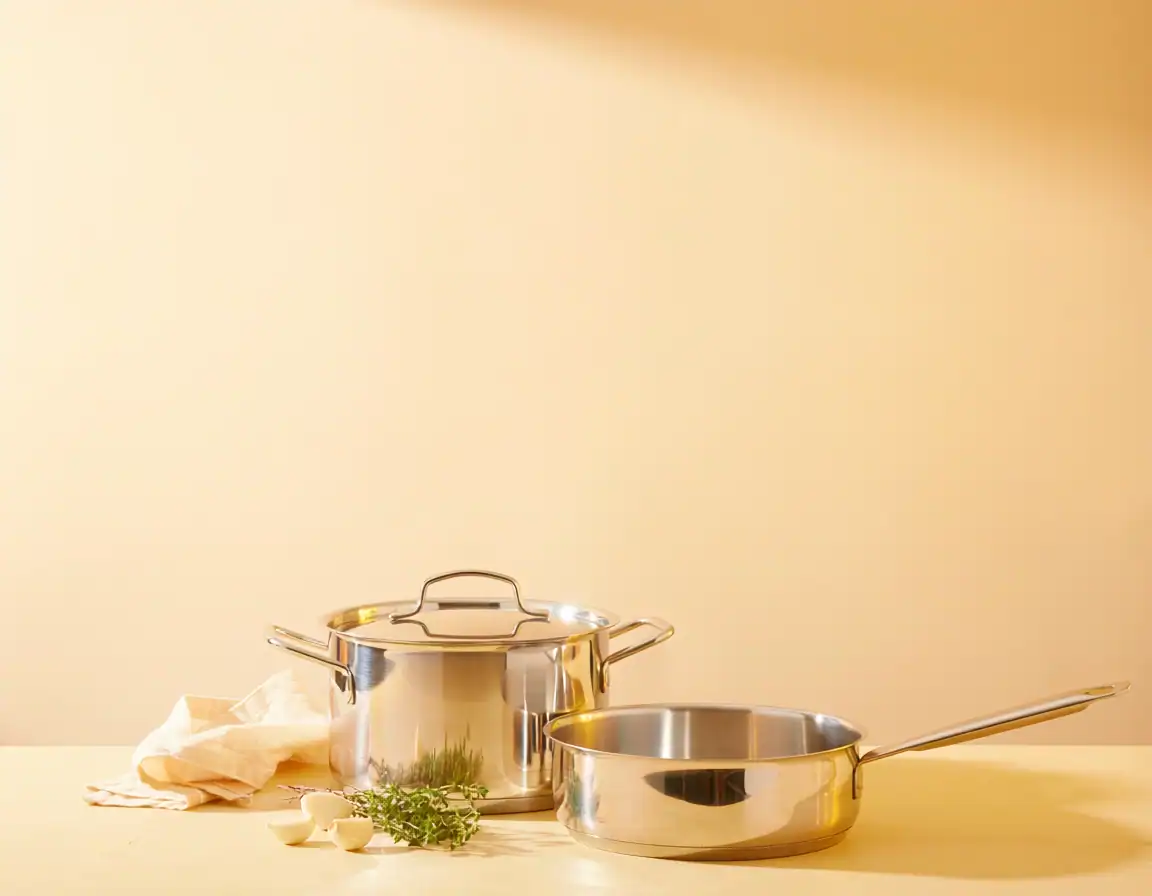
Last Reviewed: October 2026
Quick Answer
360 Cookware is our top overall pick for the best non-toxic stainless steel cookware — USA-made from surgical-grade 316 stainless steel with vapor technology that lets you cook with less oil and water, backed by a lifetime warranty. For professional-grade performance at a more accessible price, Made In and Misen both deliver 5-ply fully clad construction without the premium markup. Heritage Steel is the right choice for nickel-sensitive households, with a 316Ti surface that has the lowest nickel content of any widely available home cookware. All-Clad remains the professional benchmark for longevity, and Demeyere Atlantis is our pick for serious home cooks who prioritize heat retention above all else.
Best Picks at a Glance
Here’s how the cookware in this guide compares across steel grade, interior construction, induction compatibility, and overall weight — since those are usually what affect long-term cooking experience most.
The products we share are chosen through a low-toxic, mindful-living lens — prioritizing what goes in and on our bodies, into our homes, and back into the earth. Some links in this guide are affiliate links, which means we may earn a small commission at no extra cost to you.
Swipe to view full comparison →
| Brand | Best For | Ply | Price Range |
|---|---|---|---|
| 360 Cookware | Best overall, USA-made | Multi-ply | $$$$ |
| Heritage Steel | American-made, 316Ti option | 5-ply | $$$ |
| All-Clad | Professional standard | 3–5 ply | $$$$ |
| Made In | Best value performance | 5-ply | $$$ |
| Great Jones | Modern families, first-time buyers | 5-ply | $$ |
| Misen | Budget performance | 5-ply | $$ |
| Demeyere | Premium European, heat retention | 7-ply | $$$$ |
In everyday use, fully clad construction and comfortable weight often matter more than brand name alone, especially if the goal is cookware that heats evenly and lasts for years.
Why Stainless Steel — And Why It Matters for Families
Most families start researching stainless steel after hearing concerns about non-stick coatings. Those concerns are legitimate. Traditional non-stick pans are coated with PTFE (polytetrafluoroethylene) — the material most commonly known by the brand name Teflon. While PFOA, a processing chemical once used in PTFE manufacturing, was phased out after significant health and environmental pressure, PTFE itself is still used in virtually all conventional non-stick cookware.
When PTFE is overheated — typically above 500°F, which is achievable on a gas burner on high — it begins to degrade and can release fumes that are harmful to birds and potentially concerning for humans with repeated exposure. Modern ceramic non-stick coatings are relatively new technology without long track records, and many “non-toxic” non-stick claims rely on the absence of PFOA specifically, not PTFE or other PFAS compounds.
Stainless steel sidesteps this entirely. It has no coating to degrade, no chemicals that off-gas under heat, and when properly constructed it is stable at any temperature a home kitchen produces. It is also non-reactive — unlike bare aluminum, it won’t leach into acidic foods like tomatoes, citrus, or vinegar.
The trade-off is that stainless steel requires more technique than non-stick. Food sticks if the pan isn’t properly preheated. But that’s a learnable skill — and once you have it, you’ll rarely want to go back.
Understanding Stainless Steel Construction
Before comparing brands, it helps to understand what you’re actually comparing. These terms come up constantly in cookware research and they matter.
Ply Count
Stainless steel on its own is a poor heat conductor — it heats unevenly and develops hot spots. The solution is to bond it with aluminum, which conducts heat exceptionally well. Ply count refers to how many layers of metal are bonded together in the pan.
A 3-ply pan has two layers of stainless steel surrounding one aluminum core. A 5-ply pan has alternating layers — typically stainless, aluminum, stainless, aluminum, stainless. More ply doesn’t automatically mean better. What matters most is total thickness and bonding quality. A well-made 3-ply pan can outperform a thin 5-ply pan. That said, 5-ply generally provides more even heat distribution and better retention, which matters for searing and high-heat cooking.
Fully Clad vs. Disk Bottom
Fully clad means the metal layers run through the entire pan — walls and all — not just the base. Disk-bottom cookware bonds the conductive core only to the bottom, which means the sides heat unevenly. For most serious cooking, fully clad is worth prioritizing, and all of the brands in this guide are fully clad.
Steel Grades: 18/10 vs. 316 vs. 316Ti
The numbers on stainless steel refer to the percentage of chromium and nickel in the alloy. 18/10 stainless steel (also called 304 grade) is the most common food-grade stainless — 18% chromium, 10% nickel. Both are stable and appropriate for cooking.
316 stainless steel adds molybdenum, which increases corrosion resistance and stability. It’s often called surgical-grade steel because it’s the same alloy used in medical implants. For cookware, it means a more inert cooking surface. 316Ti adds titanium to the 316 formula, further strengthening the molecular structure and reducing nickel content — this is what Heritage Steel’s Titanium Series uses.
For most families, 18/10 is perfectly appropriate. If nickel sensitivity is a concern, 316Ti cookware has meaningfully lower nickel content.
A Note on Nickel Sensitivity
Stainless steel contains nickel, and for people with documented nickel allergies or sensitivities this is worth knowing. The amount that leaches from quality stainless steel into food is very small, and lower from higher-grade steels like 316Ti. If someone in your family has a nickel sensitivity, Heritage Steel’s Titanium Series is one of the few widely available home cookware options specifically suited to this.
Ingredients to Watch For in Cookware
PTFE (polytetrafluoroethylene) — the non-stick coating found in traditional Teflon pans and many modern products marketed as ceramic-coated. None of the brands in this guide use PTFE. This is the right choice for families who want long-term stability in their cookware.
PFAS compounds — the broader class of “forever chemicals” that includes PFOA, PTFE, and many newer compounds used in non-stick manufacturing. Quality stainless steel is completely free of PFAS by nature — there is no coating involved.
Aluminum exposure — a common concern. In fully clad stainless steel cookware, the aluminum core is sandwiched between stainless steel layers and never contacts food. There is no meaningful aluminum exposure from quality fully clad stainless steel.
Lead and heavy metals — a concern with some budget imported cookware and certain ceramic glazes. All brands in this guide use verified food-grade stainless steel. This is worth checking if you ever consider budget cookware from brands not on this list.
Ceramic non-stick coatings marketed as “natural” — many of these are not true ceramic but rather a coating process combining inorganic chemicals. They can be PFAS-free but are still relatively new technology with limited long-term data. Stainless steel is the more established, stable alternative with decades of safety data.

What to Look For
Fully clad construction. This is non-negotiable for even, reliable cooking. Look for brands that explicitly state fully clad construction, not disk-bottom.
18/10 or higher steel grade. 18/10 (304) is the standard for food-grade cookware. 316 or 316Ti is higher grade and worth seeking if budget allows or nickel sensitivity is a concern.
Total thickness. Quality 3-ply runs around 2–2.5mm; quality 5-ply runs 2.5–3.5mm. Thinner pans warp more easily and heat less evenly.
Oven safety rating. Look for a minimum 500°F oven-safe rating for full versatility — all the brands here meet or exceed this.
Induction compatibility. All brands in this guide are induction-compatible. The magnetic 400-series stainless steel exterior that enables induction also contributes to durability.
Lifetime warranty. This should be a baseline expectation for quality stainless steel, not a differentiator. All brands in this guide offer it.
How to Actually Cook With Stainless Steel
The most common reason people give up on stainless steel is food sticking. This almost always comes down to one issue: the pan wasn’t hot enough before food was added.
The preheat method: Place the pan over medium heat and let it warm for two to three minutes. Test readiness by flicking a few drops of water into the pan. If they ball up and skitter across the surface — the Leidenfrost effect — the pan is at the right temperature. Add oil, let it shimmer for 30 seconds, then add food. Do not move the food immediately. It will release naturally once a sear has formed, usually two to four minutes depending on what you’re cooking.
For eggs and delicate foods: Lower heat, more fat, and patience. Stainless steel can cook eggs beautifully but requires a properly preheated pan and enough fat to create a barrier. Lower the heat more than you think you need to.
Don’t rush the sear: When protein first hits the pan it will stick slightly. This is correct — it will release when it’s ready. Forcing it tears the sear.
How to Clean Stainless Steel
After cooking: Let the pan cool slightly before washing. Extreme thermal shock from cold water on a very hot pan can cause warping over time. Warm soapy water and a non-abrasive sponge handle most cleaning.
For stuck-on bits: Add a small amount of water to the warm pan and bring to a simmer on the stove. Most residue loosens immediately.
For rainbow discoloration: This is mineral deposit from water, not damage to the pan. A small amount of white vinegar or Bon Ami powder removes it completely. Bon Ami is fragrance-free, dye-free, and chlorine-free — it’s the cleaning powder most recommended in non-toxic circles and works identically to conventional abrasive cleaners without the concerning additives. It is safe on all the brands in this guide.
For burnt-on residue: Soak in warm soapy water first, then apply a small amount of Bon Ami powder with a damp non-abrasive pad. It lifts burnt-on residue without scratching the stainless steel surface. For particularly stubborn spots, let the Bon Ami paste sit for a few minutes before scrubbing. Alternatively, you could make a baking soda paste (baking soda + water) and let that sit before scrubbing off.
Dishwasher: Most brands in this guide are technically dishwasher-safe, but hand washing preserves the finish significantly longer.
Our Top Picks
1. 360 Cookware — Best Overall
Price: $$$$ | Made in: USA | Steel grade: 316 surgical-grade | Ply: Multi-ply
360 Cookware is our top pick and a brand we use in our own kitchen. It’s one of a very small number of cookware companies still manufacturing entirely in the United States — in West Bend, Wisconsin — and the only brand on this list using surgical-grade T-316 stainless steel as the cooking surface across their entire line.
What makes 360 genuinely distinctive is the vapor cooking technology. The pots and pans are engineered with precision-fit lids that create a vapor seal, allowing food to cook in its own natural moisture at lower temperatures. This means less added oil, less water, and better nutrient retention — particularly meaningful for families cooking vegetables and proteins for young children. The 360 slow cooker, which doubles as a large stockpot, is our most-used piece.
The multi-ply construction uses alternating layers of 316 stainless steel and an aluminum alloy core for even heat distribution. The pans are heavier than most competitors — deliberately so. The additional mass contributes to heat retention and cooking stability. 360 is also recognized as a Green Power Partner by the EPA and uses green manufacturing protocols with no harmful chemicals or VOCs in production.
This is a considered investment. The surgical-grade steel, vapor technology, lifetime warranty, and USA manufacturing all justify the price point for families buying cookware they intend to keep forever.
Best for: Families who want the highest-quality USA-made stainless steel, vapor cooking capability, surgical-grade 316 steel, and cookware they’ll never need to replace.
2. Heritage Steel — Best American-Made with 316Ti Option
Price: $$$ | Made in: USA | Steel grade: 304 (Eater Series) or 316Ti (Titanium Series) | Ply: 5-ply
Heritage Steel is a Tennessee-based, family-owned manufacturer that has been handcrafting stainless steel cookware for over 40 years. They offer two collections. The Eater Series uses 304 stainless steel (18/10) with 5-ply fully clad construction — serious performance at a more accessible price. The Titanium Series uses 316Ti, adding titanium and molybdenum to the alloy for enhanced stability and meaningfully lower nickel content.
Heritage Steel is clear about their materials philosophy — they have publicly stated they consider “non-toxic” the absolute minimum bar for cookware, not a marketing point. This is why they have never made a non-stick pan despite it being the fastest-growing cookware category. Both series are oven-safe to 800°F — the highest rating on this list — induction-compatible, and backed by a lifetime warranty.
For families with nickel sensitivities, the Titanium Series is one of the very few widely available home cookware options that specifically addresses this concern with verified lower-nickel construction.
Best for: Families who want verified American manufacturing, the option of a 316Ti surface, or who have documented nickel sensitivity concerns.
3. All-Clad — The Professional Standard
Price: $$$$ | Made in: USA | Steel grade: 18/10 | Ply: 3-ply (D3) or 5-ply (D5)
All-Clad has been the professional kitchen benchmark for fully clad stainless steel cookware for decades. Made in Canonsburg, Pennsylvania, their D3 line uses tri-ply construction — one aluminum core bonded between two layers of 18/10 stainless steel. The D5 adds two additional stainless layers for more gradual, even heat distribution suited to longer cooking.
The pans heat quickly and respond precisely to temperature changes, which makes them excellent for searing, deglazing, and sauce-making where exact heat control matters. The long handles are designed to stay relatively cool on the stovetop, and the riveted construction is among the most durable on this list.
One important note: All-Clad produces both stainless steel and non-stick lines. Make sure you’re purchasing from their stainless steel collections — D3, D5, or Copper Core — and not their HA1 or NS1 non-stick lines, which use PTFE coatings.
Best for: Home cooks who want the professional benchmark, a broad range of pieces to build a matching set, and American manufacturing with decades of track record.
4. Made In — Best Value for Performance
Price: $$$ | Made in: USA and Italy | Steel grade: 18/10 | Ply: 5-ply
Made In has earned a strong following among home cooks and professional chefs by delivering 5-ply fully clad construction at a price point meaningfully below All-Clad. Their stainless steel line is manufactured in partnership with Italian cookware artisans, and the quality shows in heat distribution and long-term durability.
The 5-ply construction — stainless, aluminum, stainless, aluminum, stainless — provides excellent heat distribution and retention. Ergonomic handles with a slight upward curve feel natural during extended cooking. Made In pans are oven-safe to 800°F and induction-compatible. For families gradually upgrading from non-stick, Made In is consistently the recommendation when premium pricing isn’t the right fit.
Best for: Families who want serious professional-grade performance in fully clad 5-ply stainless without paying All-Clad prices.
5. Great Jones — Best for Families Making the Switch
Price: $$ | Made in: Various | Steel grade: 18/10 | Ply: 5-ply
Great Jones launched in 2018 to make cookware feel approachable rather than intimidating, and their stainless steel line delivers on that intent. The 5-ply fully clad construction is genuinely professional-grade, but the design is lighter, more modern, and easier to live with daily than many legacy brands — which matters when you’re building a new cooking habit alongside a new pan.
The cookware is completely PTFE- and PFOA-free, induction-compatible, and oven-safe. Their 30-day trial and free returns policy is the most generous on this list, which meaningfully reduces the risk of committing to a cookware investment before you’ve confirmed it fits your cooking style. Great Jones sets are curated around the pieces families actually use, rather than padded with rarely-touched extras.
Best for: First-time stainless steel buyers and families who want modern, approachable design with genuine fully clad construction and a generous return window.
6. Misen — Best Budget Performance
Price: $$ | Made in: Various | Steel grade: 18/10 | Ply: 5-ply
Misen was built around a direct-to-consumer model that removes retail markup from professional-grade cookware. The result is 5-ply fully clad stainless steel at a price that makes it genuinely accessible for families just beginning to build out their kitchen.
The construction is serious — sealed rims for added durability, gently rounded sides that reduce splattering and make stirring easier, and a larger cooking surface on their skillets that suits family-sized meals. Oven-safe to 500°F and induction-compatible. In independent heat testing, Misen has performed comparably to pans at twice the price. The lifetime warranty and 60-day return window are the most generous policies on this list for a brand at this price level.
Best for: Budget-conscious families who want genuine 5-ply fully clad performance without paying premium prices.
7. Demeyere — Best for Serious Home Cooks
Price: $$$$$ | Made in: Belgium | Steel grade: 18/10 | Ply: 7-ply (Atlantis)
Demeyere has been engineering stainless steel cookware since the 1970s, and the Atlantis collection is among the most precise stainless steel options available for home kitchens — particularly for heat retention.
The Atlantis line uses 7-ply construction and a proprietary surface treatment called Silvinox, which modifies the stainless steel surface at a molecular level to resist fingerprints, staining, and discoloration over decades of use. In independent heat retention testing, Demeyere Atlantis consistently outperforms competitors — after reaching 400°F and being removed from heat, it maintains significantly higher temperatures for longer, which matters for dishes that continue cooking off-heat. On induction, it boils water faster than almost any comparable pan tested.
The trade-offs are weight and price. These are heavier pans, and the price reflects the engineering investment. For most families, Made In or Heritage Steel serve daily cooking beautifully. Demeyere is suited to the home cook who specifically prioritizes heat retention and precision above all else and is prepared to invest accordingly.
Best for: Serious home cooks who want the best heat retention available in stainless steel and are prepared to invest accordingly.

How These Brands Compare
| Brand | Ply | Steel Grade | Made In | Oven Safe | 316Ti Option | Warranty |
|---|---|---|---|---|---|---|
| 360 Cookware | Multi-ply | 316 surgical | USA | Very high | No | Lifetime |
| Heritage Steel | 5-ply | 304 or 316Ti | USA | 800°F | Yes | Lifetime |
| All-Clad | 3–5 ply | 18/10 | USA | 600°F+ | No | Lifetime |
| Made In | 5-ply | 18/10 | USA/Italy | 800°F | No | Lifetime |
| Great Jones | 5-ply | 18/10 | Various | 500°F | No | Limited |
| Misen | 5-ply | 18/10 | Various | 500°F | No | Lifetime |
| Demeyere | 7-ply | 18/10 | Belgium | 600°F+ | No | Lifetime |
Budget vs. Premium
Misen and Great Jones are where most families should start if budget is a consideration. Both offer genuine 5-ply fully clad construction with return policies generous enough to reduce the risk of the purchase. They perform well for everyday cooking and represent the best value on this list.
The middle tier — Made In and Heritage Steel — is where most serious home cooks end up long-term. The performance improvement over budget options is real, the price remains reasonable, and Heritage Steel’s American manufacturing appeals strongly to families who care about where their products are made.
360 Cookware and All-Clad occupy the premium tier for different reasons — 360 for the unique vapor technology and surgical-grade 316 steel, All-Clad for the professional benchmark and the breadth of the available range.
Demeyere is a considered investment specifically suited to the home cook who prioritizes heat retention above all else and wants the best European engineering available at that price point.
Frequently Asked Questions
Is stainless steel cookware non-toxic? Yes. Quality fully clad stainless steel contains no coatings of any kind and does not release chemicals under heat at any cooking temperature. It is one of the most stable and well-studied cooking surfaces available for home use.
Does stainless steel leach into food? In trace amounts, stainless steel can release minimal minerals including chromium and nickel into food, particularly when cooking acidic ingredients. The amounts are generally considered clinically insignificant for most people. For those with documented nickel sensitivities, Heritage Steel’s 316Ti Titanium Series is a lower-nickel option specifically suited to this concern.
What’s the difference between 3-ply and 5-ply stainless steel? 3-ply has one aluminum core between two stainless layers. 5-ply adds two more layers for more gradual, even heat distribution and better heat retention. Total thickness matters as much as ply count — a thick 3-ply can outperform a thin 5-ply.
Why does food stick to stainless steel? Almost always because the pan wasn’t sufficiently preheated before adding food. Using the water droplet preheat test described above eliminates most sticking issues.
Can I use metal utensils on stainless steel? Yes. Unlike non-stick cookware, stainless steel is not damaged by metal utensils. This is one of the significant practical advantages of making the switch.
How long does quality stainless steel cookware last? Decades, with normal use and basic care. Most brands on this list back this with lifetime warranties. Buying quality stainless steel once is meaningfully less expensive long-term than replacing non-stick pans every few years as coatings degrade.
Should I buy a set or individual pieces? Start with one or two pieces. A 10″ or 12″ skillet and a 3-quart saucepan cover the majority of everyday cooking. Get comfortable with the preheat technique before expanding.
What’s the best first piece to buy? A 10″ skillet. It handles eggs, proteins, vegetables, pan sauces, and most weeknight cooking. Once you have the preheat technique down on a skillet, everything else follows naturally.
Final Thoughts
Switching to stainless steel is one of the most lasting kitchen changes a family can make. Unlike most household swaps, quality stainless steel pays for itself over decades — in performance, in the simplicity of a cooking surface you understand completely, and in not replacing non-stick pans every few years as coatings degrade.
Start wherever your budget and comfort allow. One well-chosen skillet and a willingness to learn the preheat technique is all it takes to make the switch stick — and it usually does.
Bottom Line
The best non-toxic stainless steel cookware for most families is 360 Cookware for USA-made surgical-grade 316 steel and vapor cooking technology, Heritage Steel for American-made 5-ply construction with a 316Ti option for nickel-sensitive households, and Made In or Misen for professional 5-ply performance at a more accessible price. Great Jones is the most approachable entry point for first-time buyers. All-Clad is the long-established professional benchmark. Demeyere Atlantis is the highest-performing option available for serious home cooks.
Related Guides
- Best Stainless Steel Electric Kettle (Plastic-Free)
- Best Non-Toxic Dishwasher Detergent
- Best Non-Toxic Dish Soap
- Best Non-Toxic Water Filter for Families
- Best Non-Toxic Hand Soap
- Best Stainless Steel Water Bottle
