Last Reviewed: October 2026
Quick Answer
The best non-toxic baking sheets are uncoated stainless steel, with no non-stick coating anywhere on the surface your food touches. Our top pick is the 360 Cookware Large Cookie Sheet: a multi-ply, American-made stainless steel pan with a sealed aluminum core and no PFAS, PFOA, PFOS, or PTFE. All-Clad and Hestan make clad stainless alternatives, and Wildone is a budget-friendly uncoated option.
Why We Skip Non-Stick Baking Sheets
I’m writing this in October because holiday baking is about to start, and a baking sheet is one of the few pieces of bakeware that gets used constantly: cookies, roasted vegetables, rolls, sweet potatoes – you name it. It’s worth getting one that is built to last.
Many families, like ours, choose to skip non-stick baking sheets because the coating is the unknown. Traditional non-stick coatings are typically PTFE-based, part of the PFAS family, and brands rarely disclose the full formula, especially for “PFOA-free” or ceramic-style coatings. The Ecology Center’s testing found PTFE on about 20% of the non-stick baking pans it tested, and coatings can scratch and wear over time. Baking sheets also take a lot of metal-spatula scraping and high oven heat, which is exactly when coatings wear fastest.
Uncoated stainless steel avoids the question entirely. There is nothing on the surface to flake, and it doesn’t react with acidic foods like tomatoes or citrus the way bare aluminum can. We break down what each baking sheet is made of below. If you’re also rethinking the pots & pans on your stovetop, see our guide to non-toxic stainless steel cookware.

What to Look For in a Non-Toxic Baking Sheet
An uncoated stainless cooking surface. Look for the words “no non-stick coating” or “zero chemical coatings” and for a named steel grade, like 304 (also called 18/10 or 18/8).
A sealed core, not an exposed aluminum surface. Aluminum conducts heat well, which is why many stainless sheets are “clad” (layered) with an aluminum core sandwiched between stainless layers. The key is that the aluminum is fully enclosed and never touches food. Bare aluminum or aluminized steel sheets are a different story, since food contacts the aluminum directly.
Steel grade, if you’re nickel-sensitive. 304 / 18/10 stainless contains nickel. Most people tolerate it well, but if you’re sensitive, 18/0 stainless is nickel-free, though it is usually used in thinner, single-layer pans that heat less evenly.
Thickness and a sturdy rim. Thin single-layer sheets can warp in a hot oven. Multi-ply and heavier-gauge pans resist warping.
Where it’s made. Material safety and country of origin are separate questions. We list where each pick is made so you can decide what matters to you.
Honest tradeoffs: Stainless steel isn’t naturally slick, so food can stick if you put it straight on the pan. Lining the pan with unbleached parchment, or rubbing it with a little butter or coconut oil, takes care of that. Stainless also doesn’t spread heat as evenly as aluminum on its own, which can mean cookies that are darker in some spots than others. That’s why we favor clad pans, which have an aluminum layer sealed inside, so you get that even heating without the aluminum touching your food.

Our Top Picks at a Glance
The products we share are chosen through a low-toxic, mindful-living lens — prioritizing what goes in and on our bodies, into our homes, and back into the earth. Some links in this guide are affiliate links, which means we may earn a small commission at no extra cost to you.
A quick key before the table: “Clad” means layers of metal bonded together, usually stainless steel on the outside with an aluminum core in the middle for even heating. “Single-layer” means one solid sheet of stainless steel with no core. Price tiers are relative: Budget, Mid, or Premium.
Swipe to view full comparison →
| Pick | Construction | Made in | Size (outer) | Best for | Price tier |
|---|---|---|---|---|---|
| 360 Cookware Large Cookie Sheet | Clad, 304 stainless, sealed aluminum core | USA (West Bend, WI; global materials) | 17.5″ x 14.22″ | All-around cookies and holiday baking | Premium |
| 360 Cookware Small Cookie Sheet | Clad, 304 stainless, sealed aluminum core | USA | 12″ | Small batches and toaster ovens | Mid-Premium |
| 360 Cookware Jelly Roll Pan | Clad, 304 stainless, sealed aluminum core | USA | 13.87″ x 10.02″ | Bars, roasted veggies, anything that might spill | Premium |
| All-Clad Stainless Cookie Sheet, 12″ x 17″ | Tri-ply clad stainless with aluminum | Designed in PA, made in China | 12″ x 17″ | Larger batches in a trusted brand | Premium |
| All-Clad Stainless Jelly Roll Pan, 10″ x 15″ | Tri-ply clad stainless with aluminum | See flag | 10″ x 15″ | Bars, rolled cakes, roasting | Premium |
| Hestan OvenBond Tri-Ply Half Sheet Pan | Tri-ply clad, 18/10 stainless, aluminum core | China | 13″ x 18″ half sheet | Standard half sheet with matching racks | Premium |
| Wildone Baking Sheet Set of 3 | Single-layer stainless, uncoated | China (per third-party listings) | 3 sizes: 15.8″, 12.25″, 9.37″ long | Budget multi-pan setups | Budget |
1. 360 Cookware Large Cookie Sheet — Our Top Pick
Best for: Everyday and holiday baking
This is the one I reach for. It’s a multi-ply sheet with 304 stainless steel on both the cooking surface and the exterior, and an aluminum core sealed in between so it never touches your food. 360 states it has “zero chemical nonstick coatings,” is made without PFAS, PFOA, PFOS, or PTFE, and is lead-free.
What it’s made of:
- 304 stainless steel cooking surface: The part your food touches. Non-reactive with acidic ingredients, durable, and uncoated.
- Sealed aluminum core: Spreads heat evenly and helps resist warping, fully enclosed between steel layers.
- Stainless exterior: Protects the core and makes the pan sturdy. (360’s materials page lists a 400-series exterior for bakeware, while a product Q&A says 304; we’ve asked them to clarify.)
- No coating of any kind: No PTFE, no ceramic sol-gel, nothing to wear off.
Good to know: The outer size is 17.5″ x 14.22″, with a roughly 16.5″ x 12.5″ cooking area, so it’s a hair smaller than a standard 13″ x 18″ half sheet. Oven-safe to 500°F. 360 recommends hand washing, since harsh dishwasher detergents can damage the aluminum within the construction, and suggests a vinegar-and-water wipe for any blue or rainbow discoloration. It’s American-made (West Bend, Wisconsin, with global materials) and backed by a lifetime warranty. It’s also a significant investment, which is why it’s in the Premium tier.
Shop 360 Cookware Large Cookie Sheet →
Also available in a smaller size: 360 Cookware Small Cookie Sheet. It has the same 304 stainless clad build and sealed aluminum core, in a 12″ size that’s best for anyone who bakes about a dozen cookies at a time. 360 says its thick-gauge build resists warping. Its product page says dishwasher-safe while 360’s newer pages say not to use the dishwasher, so hand washing is the safe call and what we do.
Shop 360 Cookware Small Cookie Sheet →
2. 360 Cookware Jelly Roll Pan — Best for Bars and Sheet-Pan Dinners
Best for: Anything with a lip: bars, roasted vegetables, spill-prone bakes
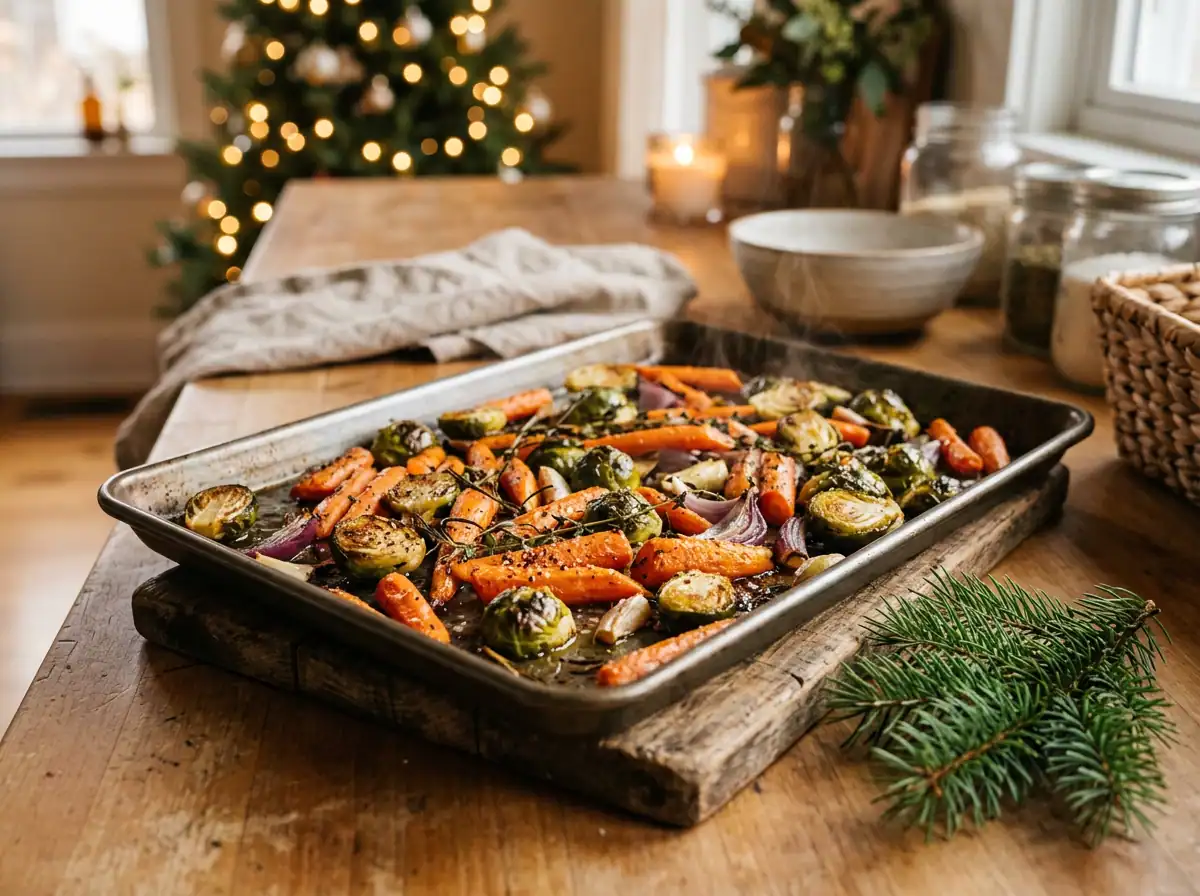
Same construction as the Large Cookie Sheet, but with a nearly 1-inch raised rim, which makes it more versatile for the holiday table: brownies for a cookie swap, roasted carrots and Brussels sprouts, sheet-pan dinners.
What it’s made of:
- 304 stainless steel surface: Uncoated, with no chemical non-stick layer.
- Sealed aluminum core: Even heat, no food contact.
- Raised rim: Holds juices and keeps batter or oil from running over.
Good to know: At 13.87″ x 10.02″ it’s a compact pan, ideal for smaller ovens and smaller households. 360 recommends greasing or lining the pan for baked goods, and a little oil for roasting. Oven-safe to 500°F, hand wash.
Shop 360 Cookware Jelly Roll Pan →

3. All-Clad Stainless Bakeware — Cookie Sheet and Jelly Roll Pan
Best for: A familiar clad stainless brand, with the tradeoff that it’s made overseas
All-Clad’s newer stainless bakeware line is tri-ply: stainless steel bonded with aluminum, a polished stainless interior, and a brushed exterior. All-Clad says the pans are oven and broiler safe to 600°F, recommends hand washing, and backs them with a limited lifetime warranty.
What it’s made of:
- Polished stainless interior: An uncoated cooking surface. This is the stainless line, not All-Clad’s Pro-Release non-stick bakeware, which uses a ceramic-reinforced non-stick coating we skip.
- Bonded aluminum: Even heat across the pan, resistant to warping per All-Clad.
- Low rim on the cookie sheet and 1-inch walls on the jelly roll pan: The 12″ x 17″ cookie sheet slides baked goods off easily, while the 10″ x 15″ jelly roll pan contains batter and juices.
Good to know: All-Clad describes the 12″ x 17″ cookie sheet as “Designed in Canonsburg, PA – USA, Made in China.” Many people associate All-Clad with American manufacturing, which is true of some of its cookware, so we think it’s worth being clear that this bakeware is not. We couldn’t confirm the origin or exact steel grade of the jelly roll pan from the brand’s page.
Shop All-Clad Stainless Cookie Sheet, 12″ x 17″ →
Shop All-Clad Stainless Jelly Roll Pan, 10″ x 15″ →
4. Hestan OvenBond Tri-Ply Half Sheet Pan — Best Standard Half Sheet
Best for: A full-size 13″ x 18″ half sheet that fits standard racks
Hestan’s OvenBond line is tri-ply: 18/10 stainless steel bonded around an aluminum core, with a brushed stainless cooking surface and no coating. It’s the pan to look at if you want a standard half sheet size, which the 360 Large Cookie Sheet isn’t quite.
What it’s made of:
- 18/10 stainless steel surface: Uncoated and non-reactive with acidic ingredients.
- Aluminum core: Sealed between the stainless layers for even heat. Hestan describes the construction as thermal-tested to resist warping.
- Half sheet size with handles: An 18″ x 13″ cooking surface, oven-safe to 600°F, and Hestan sells matching stainless racks.
Good to know: Hestan says its OvenBond sheet pans and bakers are made in China, because its Italian machinery can’t produce rectangular shapes, using the same metals as its Italian factories. Hestan also makes non-stick lines, so make sure you’re buying OvenBond (the stainless line) and not a TITUM piece. Hand washing is the safest care routine.
Shop Hestan OvenBond Half Sheet Pan →

5. Wildone Baking Sheet Set of 3 — Best Budget Pick
Best for: Stocking up for cookie-swap season without a big spend, or a no-aluminum option
This set of three comes in roughly 15.8″, 12.25″ and 9.37″ lengths, so you get a size for everything from a big batch of cookies to a toaster oven. The listing describes pure stainless steel “without chemical coating or any other materials,” with a mirror finish to reduce sticking.
What it’s made of:
- Uncoated stainless steel: No non-stick coating, per the listing. Third-party sources describe it as 18/0 (nickel-free) food-grade stainless, though we couldn’t confirm that on the listing itself.
- Single-layer construction: No aluminum anywhere in the pan. That also means no aluminum core to even out the heat.
- Rolled edges: Smooth edges for easy handling.
Why it costs so much less: The price difference comes down to how the pans are built and sold, not a hidden ingredient. A clad pan bonds layers of stainless steel around an aluminum core, which takes more material, more manufacturing steps, and tighter quality control. A single-layer pan is a stamped sheet of one metal. Wildone is also an Amazon-first brand, so there is no retail markup, but we also found no published pan thickness, steel-grade documentation, brand website, or warranty details. Wildone’s pans are made in China, per third-party sources and listings.
Good to know: The listing states a maximum of 450°F, which is lower than the 500–600°F ratings on the clad pans above. Some owners report single-layer pans like these flexing in the oven. We recommend this as an uncoated, budget-conscious starting point, not as a pan to buy for decades. These are best washed by hand to keep the mirror finish.
Shop Wildone Baking Sheet Set of 3 →

Where Each Pick Is Made
Material safety and where something is made are separate questions, so here is each pick’s origin in one place. 360 Cookware is made in West Bend, Wisconsin, with global materials. All-Clad’s cookie sheet is designed in Pennsylvania and made in China, and Hestan’s OvenBond bakeware is made in China, according to the brands. Wildone’s pans are made in China per third-party listings. If American manufacturing matters to you, 360 is the one pick here that is made in the USA.
A Note on Certifications
There is no widely used third-party certification for baking sheets, so we evaluate the materials directly: what the cooking surface is made of, whether any coating is present, and whether any aluminum touches food. Brand statements, like 360’s “made without PFAS, PFOA, PFOS or PTFE,” are useful but are claims the brand makes about itself.
What We Skip, and Why
Non-stick (PTFE) baking sheets. Coating formulas aren’t fully disclosed, and the surface wears with use.
Ceramic-coated sheets. “Ceramic” non-stick is usually a proprietary sol-gel coating over aluminum, and it tends to wear out within a few years.
Bare aluminum or aluminized-steel sheets. Great heat conductors, but food contacts the aluminum directly, and aluminum can react with acidic foods. If you love your Nordic Ware, you’re not alone. It’s a well-made American brand; our preference is simply a different material.
Silicone baking mats. Studies, including testing by the European Consumer Organization, have found some silicone bakeware releases compounds, especially at higher heat or when not fully cured. Unbleached parchment paper is our simple swap, though most parchment also carries a silicone coating, so it’s worth choosing a brand that has been tested (see the tips below).
Tips for Holiday Baking on Stainless Steel
- Line or grease the pan. Parchment or a light brushing of butter or oil prevents sticking. Not all parchment is the same: Mamavation had popular brands tested for fluorine, a marker for PFAS, and found none detected in If You Care, Katbite, and Gifbera, and 12–14 ppm in Kirkland and Reynolds. Most parchment has a silicone coating, so for a coating-free option, Mamavation also tested Baar Patapar, an uncoated vegetable parchment with no fluorine detected. We use Katbite unbleached parchment sheets.
- Preheat the oven fully. Stainless releases food more easily on a hot, even surface.
- Let it cool before washing. Hand wash with warm soapy water and a non-toxic dish soap. For blue or rainbow heat tint, a vinegar-and-water wipe usually clears it.
- Skip the dishwasher for clad pans. If you do run other stainless pieces through the dishwasher, a non-toxic dishwasher detergent keeps the rest of the load simple too.
- Check rack sizes. A standard 12″ x 17″ cooling rack fits a 13″ x 18″ half sheet like Hestan’s, which also has matching racks. The 360 Large Cookie Sheet’s cooking area is a little narrower, so measure first.
More Stainless Swaps for a Low-Toxic Kitchen
If you’re already moving to stainless for baking, the same logic applies elsewhere in the kitchen. A stainless steel water bottle and a plastic-free stainless steel electric kettle replace two everyday items that often involve plastic, and a non-toxic water filter covers what goes into the kettle, water bottle – and ulimtately, your body!
Frequently Asked Questions
Are stainless steel baking sheets non-toxic?
Uncoated stainless steel is one of the most stable options for baking. It has no coating to wear off and doesn’t react with acidic foods the way bare aluminum can. Stainless steel can release trace amounts of nickel and chromium, mostly from brand-new pans and with acidic foods; most people aren’t affected, and nickel-sensitive families may prefer 18/0 stainless.
Is aluminum in a clad baking sheet safe?
In the pans we recommend, the aluminum core is fully sealed between layers of stainless steel and never touches your food. The concern is with bare aluminum surfaces, where food contacts the metal directly.
Are non-stick baking sheets safe?
Many families prefer to skip them. Traditional non-stick coatings are typically PTFE-based (a PFAS), the full formulas are rarely disclosed, and coatings can wear down over time and at high heat.
Do stainless steel baking sheets warp?
Thin single-layer pans can. Thicker clad pans, like the 360 sheets, are designed to resist warping. Avoid putting a hot pan under cold water.
Can I put stainless steel baking sheets in the dishwasher?
We recommend hand washing. 360 specifically advises against the dishwasher for its bakeware because harsh detergents can damage the exposed aluminum edges within the construction, and All-Clad also recommends hand washing for its stainless bakeware.
How do I stop food from sticking to a stainless steel baking sheet?
Line the pan with unbleached parchment or lightly grease it, and preheat the oven fully.
What is the best non-toxic baking sheet?
For most families, an uncoated stainless steel sheet with a sealed aluminum core is the best balance of safety and performance. Our top pick is the 360 Cookware Large Cookie Sheet, with Hestan OvenBond as a standard half sheet alternative.
Are aluminum baking sheets like Nordic Ware safe?
Nordic Ware is a well-made American brand, but most of its sheet pans have a bare aluminum cooking surface, which can react with acidic foods like tomatoes and citrus. Many families prefer uncoated stainless steel for everyday baking so that food never touches aluminum.
Are silicone baking mats a safe alternative to non-stick pans?
Food-grade silicone is more stable than many coatings, but some testing has found it can release compounds at higher heat, especially if it isn’t fully cured. We keep it simple with unbleached parchment paper on a stainless pan.
Why are some stainless steel baking sheets so much cheaper than others?
Price mostly reflects construction and sourcing. Clad pans bond stainless steel around an aluminum core, which takes more material and manufacturing steps, while budget single-layer pans are stamped from one metal and typically offer less even heating and less warp resistance. Where a pan is made and what warranty comes with it also affect the price.
Bottom Line
If you want one baking sheet you’ll use for decades, the 360 Cookware Large Cookie Sheet is the pan I reach for: uncoated, sealed-core stainless, made in the USA. All-Clad and Hestan are well-known clad alternatives, though both are made overseas, and Wildone is a sensible uncoated option for a smaller budget. Start with the pan you use most, and you don’t have to replace everything at once.
Related Guides
Baking is just one slice of a low-toxic kitchen, so here are a few next reads:
- Best Stainless Steel Cookware (Non-Toxic)
- Best Non-Toxic Dish Soap
- Best Non-Toxic Dishwasher Detergent
- Best Non-Toxic Water Filter for Families
- Best Stainless Steel Water Bottle
- Best Plastic-Free Stainless Steel Electric Kettle
