Last Reviewed: October 2026
Quick Answer
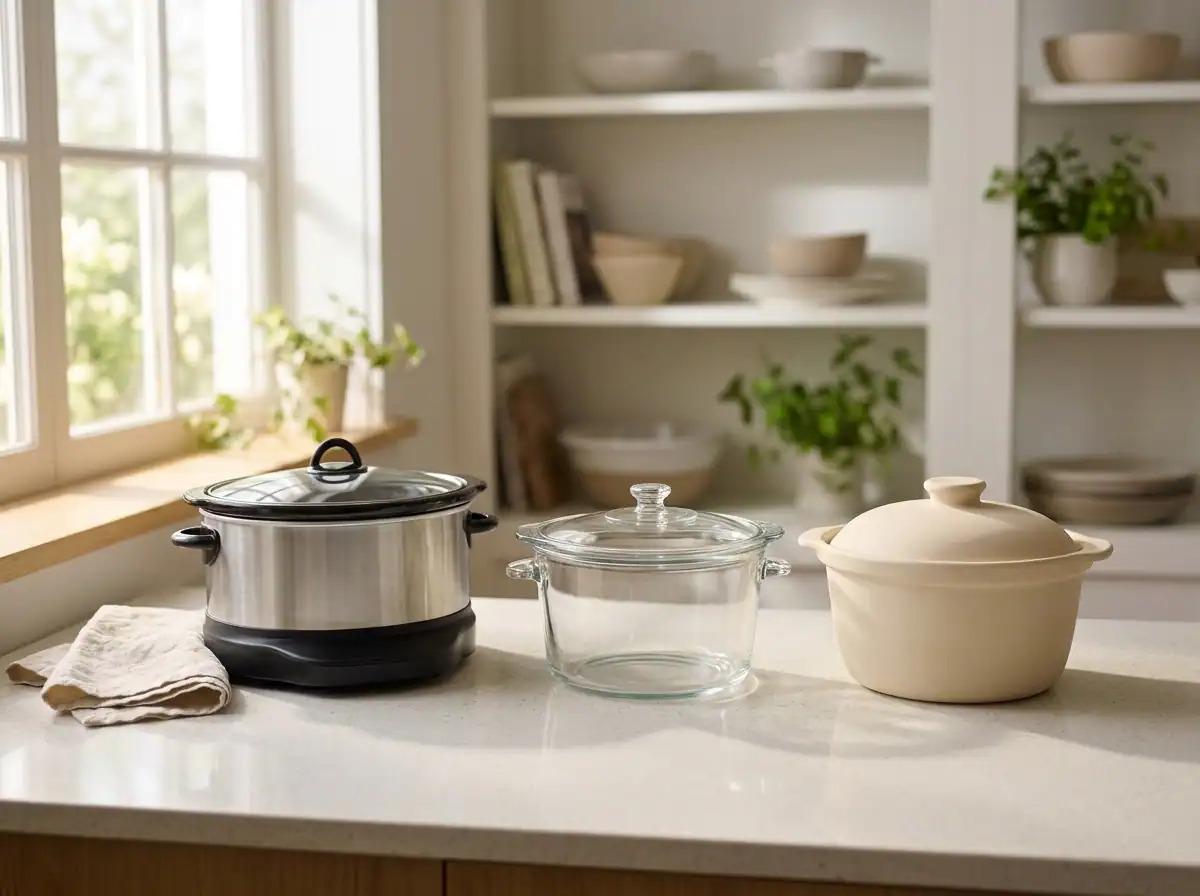
The best non-toxic slow cooker has a stainless steel or glass cooking surface with no coating of any kind, and as little plastic as possible near your food. Our top pick is the 360 Cookware Slow Cooker Set: a stainless steel pot and lid that sit on an electric base, so the heating element never touches your food. It’s made in the USA. For a glass option, the Magnifique Glass Pot Multi-Cooker has a borosilicate glass pot and lid, and the Magnifique Claypot Multi-Cooker has a kaolin clay pot and lid if you’d rather avoid both nickel and glass. If you want one appliance that slow cooks and pressure cooks, the Instant Pot Duo has an uncoated stainless steel pot, though it has a silicone sealing ring and some plastic lid parts.
Why We Skip Most Conventional Slow Cookers
A slow cooker is one of the most demanding pieces of cookware in the kitchen. Food sits in it for six to ten hours, often with liquid and often with something acidic like tomatoes or vinegar. That’s exactly the situation where the material of the pot matters most.
Most slow cookers use one of two inserts. The first is a glazed ceramic crock. Modern slow cookers sold in the US are required to meet FDA and California Prop 65 limits for lead and cadmium in those glazes, but a legal limit isn’t the same as zero, and most brands don’t publish third-party glaze test results. The CDC says there is no known safe level of lead exposure for children, so many families, including ours, prefer to skip the question. The second is a nonstick-coated insert, usually a coating over cast aluminum. Some are PTFE-based (polytetrafluoroethylene, the nonstick coating best known by the brand name Teflon, and one of the PFAS, short for per- and polyfluoroalkyl substances, often called “forever chemicals”), others are a ceramic-style coating, and the full formulas are rarely disclosed. Coatings also wear down over time, and a slow cooker insert gets plenty of scrubbing and stirring.
There’s a second, quieter question that’s specific to appliances: plastic. Lids, knobs, gaskets and stirring paddles are often plastic or silicone, and in a slow cooker the steam from your food touches the lid for hours. We can’t remove every polymer from every appliance, but we can choose the ones that keep it away from the food, and we say plainly where it remains.
If you’re also rethinking the pots on your stovetop and the pans in your oven, see our guides to non-toxic stainless steel cookware and non-toxic baking sheets.

What to Look For in a Non-Toxic Slow Cooker
An uncoated food-contact surface. Stainless steel, borosilicate glass, or lab-tested unglazed clay. Look for the words “no nonstick coating” and a named material, not just “healthy” or “non-toxic.”
A heating base that never touches your food. The best designs keep the electrical base separate from a removable pot. Anything food touches should be removable, washable and made of a material you can name.
Plastic kept away from the food. Check the lid, the knob and any gasket. Glass or stainless lids with metal handles are ideal. Where a silicone gasket is unavoidable, as with pressure cookers, it should be food-grade and replaceable.
A pot that fits how you cook. Browning the meat in the same pot you slow cook in saves a pan and adds flavor. Only some designs can go on the stovetop.
Nickel considerations. Stainless steel contains nickel, and a small amount can release into food, mostly from new pots and acidic foods. Most people are unaffected. If you’re nickel-sensitive, glass or clay is worth a look.
Honest tradeoffs: Stainless steel slow cookers cost more than conventional ones and have fewer programmable features. Glass can break, and the glass pot we feature is made for its electric base only, so you can’t brown in it on the stove or finish it in the oven. Neither is a set-and-forget compromise for everyone, so we share both.

Our Top Picks at a Glance
The products we share are chosen through a low-toxic, mindful-living lens — prioritizing what goes in and on our bodies, into our homes, and back into the earth. Some links in this guide are affiliate links, which means we may earn a small commission at no extra cost to you.
A quick key before the table: “Food-contact surface” is the material your food touches directly. “Plastic near food” covers the parts in the steam path, like the lid and any sealing gasket, rather than the outside of the appliance. Price tiers are relative: Budget, Mid, or Premium.
Swipe to view full comparison →
| Pick | Type | Food-contact surface | Plastic near food | Best for | Price tier |
|---|---|---|---|---|---|
| 360 Cookware 4 Quart Slow Cooker Set | Stovetop-to-base slow cooker | Stainless steel pot and lid | None (stainless pot and lid) | Most families, our top pick | Premium |
| 360 Cookware 6 Quart Slow Cooker Set | Stovetop-to-base slow cooker | Stainless steel pot and lid | None (stainless pot and lid) | Larger families and batch cooking | Premium |
| 360 Cookware 2.3 Quart Slow Cooker Set | Stovetop-to-base slow cooker | Stainless steel pot and lid | None (stainless pot and lid) | Small households, sides and dips | Premium |
| 360 Cookware Slow Cooker Base | Base only, for compatible 360 pots | Your 360 pot | None (stainless pot and lid) | Adding slow cooking to 360 cookware you own | Premium |
| Magnifique Glass Pot Multi-Cooker | Countertop multi-cooker | Borosilicate glass pot, stainless steam rack | None in the pot and lid | Watching food cook, glass-only preference | Mid |
| Magnifique Claypot Multi-Cooker | Countertop clay multi-cooker | Kaolin clay pot and lid | None in the pot and lid; base materials not published | Nickel-free cooking, searing in the same pot | Mid |
| Instant Pot Duo 7-in-1 | Electric slow cooker and pressure cooker | Stainless steel pot | Silicone sealing ring; plastic lid parts | One appliance for slow and pressure cooking | Budget |
1. 360 Cookware Slow Cooker Set — Our Top Pick
Best for: Families who want a stainless steel slow cooker that also works as everyday cookware
This is the one we reach for. In our stainless steel guide, the 360 slow cooker is the piece we use most. The idea is simple: instead of a crock that only does one job, you get a real stainless steel pot with a lid. Brown your meat or onions on the stove, set the same pot on the electric base, and let it cook. When dinner’s done, the pot goes back to being a pot.
360’s cooking surface is an uncoated, multi-ply stainless steel pot, and the base is just the heat source. Nothing your food touches is coated, silicone, ceramic or aluminum: it’s stainless steel from the pot to the lid.
What it’s made of:
- Stainless steel pot: The part your food touches. Multi-ply with a sealed aluminum alloy core for even heat, so the aluminum never contacts food. The cooking surface is surgical-grade stainless steel, free of nonstick coatings.
- Stainless steel lid: A domed lid that holds vapor in the pot so food cooks in its own moisture (more on Vapor® Cooking below). No glass seal, no gasket.
- Electric base with a steel plate: An electric heating platform with a temperature dial. The pot sits on it directly and your food never touches it.
- No coating of any kind: No PTFE, no ceramic sol-gel, no glaze.
Vapor® Cooking. The 360 pot and lid are built for Vapor® Cooking, a modern take on waterless cooking. Instead of covering food in water, you let the moisture already in your food do the work. As the food heats, that moisture turns to vapor, and the stainless steel lid holds it in so heat and moisture keep circulating around the food. On the stovetop, you start on medium heat with the lid on. When you see vapor escaping around the lid, give the lid a gentle spin. If it spins freely, the vapor seal has formed, and you turn the heat down to low and let it cook. Because the food cooks in its own moisture, its flavor stays in the pot instead of in cooking water you’d pour off, and vegetables stay flavorful instead of waterlogged. It really does work! I put a little broth and some seasonings in, and get the most tender, flavorful dishes. I know it’s hard – but try not to lift the lid, since every peek lets the vapor out and the seal has to build again. It’s a big part of why we like a stainless steel slow cooker, and you can learn the method on 360’s Vapor® Cooking page.
Good to know: The base has four settings and a temperature range of about 155°F to 255°F. It fits the 2.3-quart casserole pan, the 4-quart stock pot and the 6-quart Gourmet stock pot; it does not fit 360’s regular 6-quart or 8-quart stock pots. The pot is oven-safe to 500°F and works on any stovetop, including induction. The base is a heating appliance, so wipe it with a damp cloth and never submerge it. We hand wash the pot. 360 offers a lifetime warranty on its non-electrical parts, and the base is handcrafted in the USA.
Quick note – there’s no automatic timer to shut this off when its done, or you’re not home – so it’s worth being mindful if you cook overnight or while you’re out. We also couldn’t find a published materials list for the base’s housing and knob; they aren’t food contact, but it may worth knowing, since this is a Premium-tier purchase.
Shop 360 Cookware Slow Cooker Set →
Also available in other sizes:
Shop 360 Cookware 2.3 Quart Slow Cooker Set →
Shop 360 Cookware 6 Quart Slow Cooker Set →
Shop 360 Cookware Slow Cooker Base → If you already own a compatible 360 pot, you can buy just this
2. Magnifique Glass Pot Multi-Cooker — Best Glass Option
Best for: Anyone who wants a glass cooking pot and likes to watch dinner cook without lifting the lid
Glass-pot cookers are a newer category, and this is the one we found with a pot and a lid that are both borosilicate glass. The pot is pure glass with no coating, and it’s third-party tested for heavy metals and PFAS by Light Labs. Magnifique’s California AB 1200 chemical disclosure lists borosilicate glass and stainless steel as the food-contact materials, with no intentionally added PFAS.
What it’s made of:
- Borosilicate glass pot: A 4.5-quart removable pot. Borosilicate is the same heat-resistant glass family used in lab glassware, chosen because it handles temperature changes better than ordinary glass. No coating, no glaze.
- Borosilicate glass lid: Lets you watch the food, so you don’t lose heat by lifting it.
- Stainless steel steam rack: The only metal food-contact part. Like all stainless steel, it contains chromium, nickel and manganese.
- Electric base: The heating unit. The pot and lid are dishwasher-safe, but never submerge the base.
Good to know: There are eight modes: Slow Cook, Steam, Braise, Rice, Proof, Pasta, Oatmeal and Keep Warm. There’s no sear or sauté mode, and the pot isn’t oven or stovetop safe, so unlike the 360 you can’t brown in it. Glass can crack from sudden temperature changes, so don’t take a cold pot from the fridge to a hot base, and Magnifique’s warranty doesn’t cover thermal shock or accidental breakage. Replacement glass pots aren’t for sale yet. At 4.5 quarts, it suits small to medium families. We couldn’t find a published materials list for the base housing or lid knob. The “no plastic” claim applies to the pot, so if zero plastic anywhere is your line, ask them directly. It sits in the Mid tier.
Shop Magnifique Glass Pot Multi-Cooker →
3. Magnifique Claypot Multi-Cooker — Best Clay Option
Best for: Anyone who wants to avoid nickel and likes clay’s slow, even heat, with the option to brown in the same pot
Clay is one of the oldest slow-cooking materials there is. This is an electric multi-cooker with a kaolin clay pot and a kaolin clay lid, so clay is the only thing your food touches. Both are third-party tested by Light Labs for heavy metals and PFAS. Unlike the glass pot from the same brand, the clay pot is high-temperature clay, so you can sear and sauté in it before slow cooking.
What it’s made of:
- Kaolin clay pot: The part your food touches. Pure kaolin clay, with the pot’s glaze included in the third-party testing. Nickel-free, so it’s an option if stainless steel doesn’t suit someone in your household.
- Kaolin clay lid: Keeps moisture and heat in the pot. Clay, not glass or plastic.
- Electric base: The heating unit, rated at 1,130 watts. It doesn’t touch your food, and we couldn’t find a published materials list for the housing.
- Wooden spatula and trivet: Included in the box, so there’s no plastic utensil to reach for.
Good to know: The version we link first is the 4.5-quart size, and Magnifique also makes 4- and 6-quart options in a different shape. There are eight modes, including Slow Cook, Braise, Sear/Sauté and Keep Warm, plus rice, pasta and oats, with slight differences between the two sizes. The pot and lid are dishwasher safe and oven safe to 500°F. Clay can crack from sudden temperature changes, so never put a cold pot on a hot surface, and Magnifique’s warranty doesn’t cover thermal shock. It’s heavy, about 13.5 pounds for the smaller size, and the footprint is wide at 17.5 inches. It sits in the Mid tier.
Shop Magnifique Claypot Multi-Cooker →
Shop Magnifique Claypot Multi-Cooker, 4 and 6 Quart Options →
4. Instant Pot Duo 7-in-1 — Best Electric Slow and Pressure Cooker, With Caveats
Best for: One countertop appliance that slow cooks, pressure cooks and makes rice, at a more accessible price
We want to be upfront: the Instant Pot doesn’t meet our strictest “no plastic near food” standard, which is why it’s here with caveats rather than as a top pick. What it does well is the part that matters most: the pot your food sits in is uncoated stainless steel. The silicone seal is the tradeoff: every pressure cooker needs a sealing gasket, and almost all are silicone. It’s generally considered stable, but long-term data on low-level migration into food is limited.
What it’s made of:
- 18/8 stainless steel inner pot: Uncoated, with a tri-ply bottom for even heating. No nonstick coating, no ceramic coating. Dishwasher-safe.
- Stainless steel lid liner and float valve: The parts in the steam path are metal.
- Silicone sealing ring: The one polymer your food’s steam touches. Food-grade silicone is stable at cooking temperatures, but long-term data on low-level migration is limited. Replace the ring every 12 to 18 months, or sooner if it cracks or stops sealing.
- Polypropylene lid and housing parts: BPA-free plastic that sits above the steam zone and isn’t meant to touch food during standard cooking.
Good to know: It comes in 3-, 6- and 8-quart sizes. Make sure you buy the stainless steel version, because some Instant Pot models ship with a coated pot. Its slow cook function heats from the bottom, so it won’t behave exactly like a traditional slow cooker; it’s convenient, but it isn’t the same as the 360 for long, hands-off braises. It’s a Budget-tier appliance, and a reasonable compromise if one machine is more important to you than perfect materials.
What We Skip, and Why
Glazed ceramic (stoneware) crocks. These are the standard Crock-Pot and Hamilton Beach design. Modern ones meet FDA and Prop 65 limits for lead and cadmium, but we don’t see third-party glaze testing published by the brands. We’d rather choose a material where there’s nothing to wonder about.
Nonstick-coated inserts. Includes PTFE-based and “ceramic” coatings. All-Clad’s 7-quart digital slow cooker, for example, has a cast aluminum insert with a nonstick ceramic coating, and it’s made in China. Some other roundups call it PFAS-free, but because the coating sits over aluminum and can wear, we skip it.
Anything where we can’t find what the food touches. If a brand won’t tell you what the pot is made of, that’s the answer we need.

Why You Won’t See Caraway, Our Place or GreenPan Here
If you’ve searched for a non-toxic slow cooker, you’ve probably seen Our Place, Caraway and GreenPan near the top of the results. They’re well-known brands, so we want to explain why they aren’t in our picks. We’re not saying these products are unsafe. A PFAS-free coating is a real step up from a PTFE one. Our line is simply stricter: we look for a food-contact surface with no coating at all, and as little plastic near the food as possible.
Our Place. The Dream Cooker is a popular 6-quart pressure cooker and multi-cooker. Its inner pot is aluminum with a PFAS-free ceramic nonstick coating, and the base and outer lid are plastic, with a stainless steel underside on the lid. Ceramic nonstick is usually a thin coating applied over metal, the full formula isn’t disclosed, and it tends to wear with use and scrubbing. That puts a coating between your food and the metal, and it puts plastic on the outside of the cooker, which is why it falls short of our standard.
Caraway. Caraway is best known for ceramic-coated cookware, including a small stovetop cooker called the Petite Cooker. We couldn’t find an electric slow cooker or pressure cooker from Caraway, so if you’ve seen the name in your searches, it’s most likely about their coated pots and pans. The same reasoning applies: we look for a pot with no coating.
GreenPan. The Elite slow cooker has a hard-anodized aluminum pot with a Thermolon ceramic nonstick coating that’s free of PFAS, PFOA, lead and cadmium. It’s a thoughtful product for people who want a nonstick surface. It’s still a coating over aluminum, so we left it off.
A quick note on the word “ceramic,” because it causes a lot of confusion. A “ceramic nonstick” pot is metal with a ceramic-style coating sprayed on. A ceramic stoneware crock is solid glazed pottery. They’re different materials with different concerns, and neither is the clay or glass we’re featuring.
Other popular crocks. Crock-Pot and Hamilton Beach use glazed stoneware, which we cover above, and Cuisinart’s Cook Central multi-cooker has a nonstick-coated aluminum pot.
Can I Slow Cook Without an Appliance?
Yes. Any heavy stainless steel pot with a lid, including the 360 pot on its own or a stock pot from our stainless steel cookware guide, can do low-and-slow cooking in an oven set around 225°F to 250°F, or on your lowest stovetop setting. The pot is oven-safe to 500°F, which is far higher than slow cooking needs. It uses more attention than a countertop appliance, so check it occasionally. If you’re not ready to buy a dedicated slow cooker, this is a good place to start.

Tips for Slow Cooking in Stainless Steel and Glass
- Brown first, then slow cook. Searing in the stainless pot before it goes on the base builds flavor. Let the pot cool a little before adding cold liquid.
- Let the food’s own moisture do the work. In a 360 pot, water-rich ingredients like onions, tomatoes, mushrooms and vegetables release plenty of liquid on their own as they heat. Start with little to no added water, keep the lid on, and let the vapor circulate. Drier foods may need a small splash, about a quarter cup, to get the vapor going.
- Keep the lid on. Every time you lift it, heat and vapor escape and the seal has to build again.
- Protect glass from thermal shock. Never move a glass pot straight from the fridge to a hot base, or a hot pot to a cold or wet surface.
- Hand wash stainless. Dry the pot right away to avoid water spotting. For rainbow heat tint, a vinegar-and-water wipe usually clears it. Use a gentle non-toxic dish soap.
- Keep the base dry. Wipe electric bases with a damp cloth. They should never be submerged or put in the dishwasher.
- Replace gaskets on schedule. If you use a pressure cooker, replace the silicone gasket when it cracks, stretches or stops sealing well.
More Low-Tox Kitchen Swaps
If you’re already updating small appliances, the same logic applies to the rest of the counter. A plastic-free stainless steel electric kettle is a natural next step, and non-toxic stainless steel baking sheets cover the oven side of the kitchen.
Frequently Asked Questions
Is a stainless steel slow cooker non-toxic?
Uncoated stainless steel is one of the most stable cooking surfaces available. It has no coating to wear off and doesn’t react with acidic foods the way bare aluminum can. Stainless steel can release trace amounts of nickel and chromium, mostly from new pots and with acidic foods, and most people aren’t affected. If someone in your family is nickel-sensitive, glass or clay may be a better fit.
Is a glass slow cooker safe?
Borosilicate glass is a stable, non-reactive material with no coating, which is why we like it. The main practical risk is thermal shock: glass can crack if it goes from very cold to very hot, or the reverse. Follow the manufacturer’s care guide, avoid sudden temperature changes, and check the base and lid materials too, since “glass pot” doesn’t always mean “no plastic anywhere.” Let the pot cool before washing it, and hand wash with a soft sponge.
Are ceramic slow cooker inserts safe?
Modern slow cooker crocks sold in the US are required to meet FDA and California Prop 65 limits for lead and cadmium in the glaze. Many families are comfortable with that, and many prefer to skip it because brands rarely publish independent glaze testing. If you own a ceramic crock and aren’t ready to replace it, it’s reasonable to avoid long cooks of tomato or vinegar-heavy dishes in it.
What is the best non-toxic slow cooker?
For most families, we recommend the 360 Cookware Slow Cooker Set: an uncoated stainless steel pot and lid on an electric base, made in the USA, and designed for Vapor® Cooking, so food cooks in its own moisture. If you’d rather cook in glass, the Magnifique Glass Pot Multi-Cooker is the option we found with a glass pot and glass lid.
What is the best non-toxic slow cooker for nickel sensitivity?
Stainless steel releases small amounts of nickel, so a glass or clay pot may be a better fit if you’re sensitive. The Magnifique Glass Pot Multi-Cooker has a glass pot and lid, though its steam rack is stainless steel, so you can skip the rack, and the Magnifique Claypot Multi-Cooker has a kaolin clay pot. If nickel is a concern for you, talk with your doctor about what level of dietary nickel matters for your situation.
Is there a non-toxic pressure cooker?
Not one that is completely plastic-free, because every pressure cooker needs a sealing gasket, and nearly all of them are silicone. If you want one appliance that also slow cooks, the Instant Pot Duo has an uncoated stainless steel pot, with a silicone ring and some plastic lid parts. If you only want a pressure cooker, a stainless steel stovetop model like the Zavor DUO or Fissler Vitaquick keeps the silicone gasket as the only polymer near your food. Replace the gasket when it wears out.
Can I use my own stainless steel pot in a slow cooker base?
Only if it fits the base the manufacturer designed it for. The 360 Slow Cooker Base fits the 360 2.3-quart casserole pan, the 4-quart stock pot and the 6-quart Gourmet stock pot, and it won’t fit 360’s regular 6-quart or 8-quart stock pots. Using an unrelated pot on a heating base can heat unevenly, so stick to the manufacturer’s list.
How do I keep food from sticking in a stainless steel slow cooker?
Preheat the pot over medium heat before the food goes in, and use a little oil or butter if you’re browning. A quick test: flick a few drops of water into the pot, and when they bead up and glide across the surface, it’s ready. Let the food release on its own before you turn it. Once the lid is on and the vapor seal forms, the food’s own moisture keeps things from sticking and scorching.
Are ceramic nonstick slow cookers like Our Place and GreenPan non-toxic?
PFAS-free ceramic nonstick is a meaningful step up from PTFE, but it’s still a coating over aluminum, the formulas aren’t fully disclosed, and coatings wear down with use. The Our Place Dream Cooker, for example, has a ceramic-coated aluminum pot and a plastic base and lid, and GreenPan’s Elite slow cooker has a ceramic-coated hard-anodized aluminum pot. Caraway doesn’t make an electric slow cooker that we could find. We skip coatings entirely and choose stainless steel, glass or clay.
Stainless steel or glass: which is better for a slow cooker?
Stainless steel is more versatile and durable: it can go on the stove and in the oven, so you can brown food first, and it won’t break if you drop it. Glass is nickel-free and lets you watch your food cook, but the glass pot we feature can’t go on the stove or in the oven, and it needs more careful handling. We pick stainless for flexibility and glass if nickel or visibility matters most to you.
Bottom Line
If you want one non-toxic slow cooker to keep for years, the 360 Cookware Slow Cooker Set is the one we reach for: an uncoated stainless steel pot and lid on an electric base, and a pot you can use on the stove and in the oven too. The Magnifique Glass Pot Multi-Cooker is a thoughtful option if you want a glass pot and lid, with the tradeoffs of glass in mind, and the Magnifique Claypot Multi-Cooker is the one to look at if you’d rather cook in clay. The Instant Pot Duo is a budget-friendly compromise if you want one machine for slow and pressure cooking.
Related Guides
Slow cookers are one small part of a low-toxic kitchen, so here are a few next reads:
- Best Stainless Steel Cookware (Non-Toxic & Built to Last)
- Best Non-Toxic Baking Sheets
- Best Plastic-Free Stainless Steel Electric Kettle
- Best Non-Toxic Dish Soap
- Best Non-Toxic Dishwasher Detergent
- Best Non-Toxic Water Filter for Families
